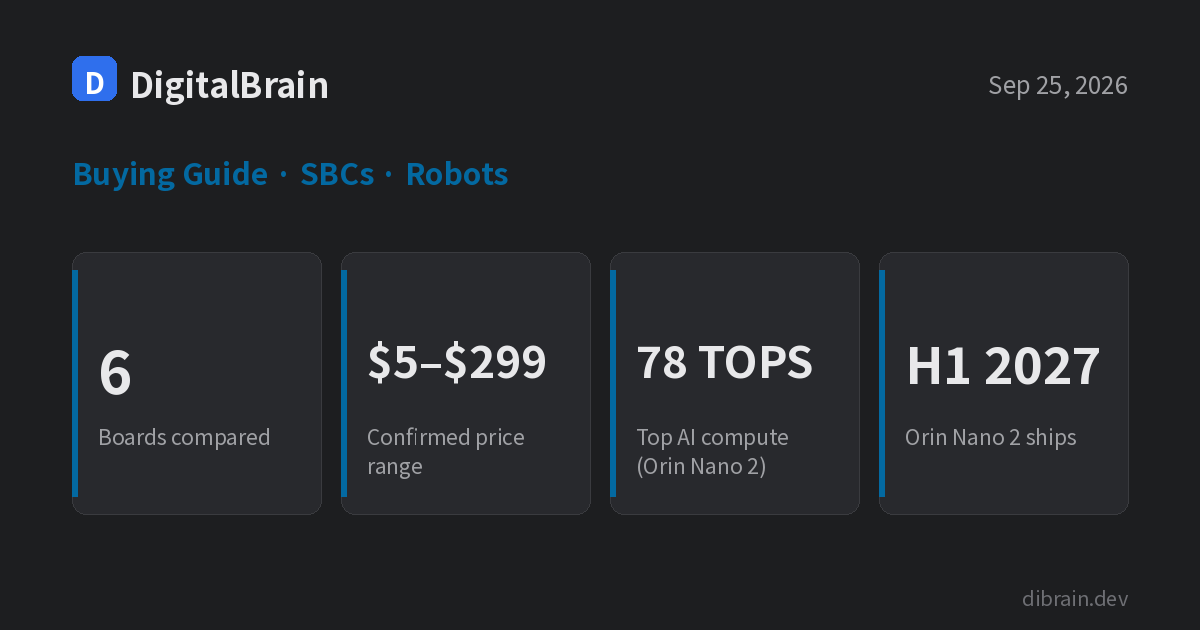
A spec sheet rarely settles which board belongs in a robot or a vision rig. The power budget and the memory ceiling usually bite before raw compute does. This page collects every board DigitalBrain has covered into one table and gets updated when a new one ships. Every number comes from the sources in the linked deep dives; anything we couldn’t confirm is marked TBC.
At a glance
| Board | Compute | Memory | Power (official) | Price | Status |
|---|---|---|---|---|---|
| NVIDIA Jetson Orin Nano 2 | 8-core Arm Cortex-A78, Ampere GPU (1,536 CUDA cores), 78 TOPS | 8GB LPDDR5X, 120GB/s | 15–40W | TBC (not announced) | Ships first half of 2027 |
| NVIDIA Jetson Orin Nano Super Developer Kit | 6-core Arm Cortex-A78AE, Ampere GPU (1,024 CUDA cores), 67 TOPS | 8GB LPDDR5, 102GB/s | 7–25W | $249 | On sale |
| Arduino VENTUNO Q | Qualcomm Dragonwing IQ8 + STM32H5 | 16GB LPDDR5 / 64GB eMMC | TBC | $299 (introductory pre-order) | Pre-order |
| Arduino UNO Q | Qualcomm QRB2210 (quad-core Cortex-A53) + STM32U585 | 2GB/16GB or 4GB/32GB | TBC | $59 (2GB) / $79 (4GB) | On sale |
| YuzukiNeko | Allwinner F101S3 (one XuanTie C907 RISC-V core, 1.008GHz) | 16MiB PSRAM | TBC | TBC | Not yet on sale |
| Raspberry Pi Pico 2 | RP2350 (2× Cortex-M33 + 2× Hazard3 RISC-V, 150MHz) | 520KiB SRAM | TBC | $5 | On sale |
Sources: NVIDIA Newsroom, SparkFun (Orin Nano Super Developer Kit), CNX Software (VENTUNO Q), Arduino Blog (UNO Q pricing), CNX Software (YuzukiNeko), Raspberry Pi (Pico 2)
The first four are Linux computers; the Pico 2 is a microcontroller; YuzukiNeko sits in between, running Linux in a Pico-sized footprint. They share a table, not a job.
Start from what you’re building
- Real-time motor and sensor control at the lowest cost: Raspberry Pi Pico 2. $5, always in stock, and you can start in bare metal, MicroPython, or CircuitPython.
- Linux and a display output in a Pico footprint: YuzukiNeko, but it isn’t on sale and has no price yet, so it’s not something to design in today.
- A hobby or classroom vision project with a camera and screen: Arduino UNO Q 4GB plus the UNO Media Carrier ($19.25). If you plan to run two cameras and a vision model together, 4GB is the safer pick over 2GB.
- Heavy on-device AI and a real-time MCU on one board: Arduino VENTUNO Q. It takes the same carrier as the UNO Q, so if all you need is a camera, the extra $240 is hard to justify.
- A CUDA-based vision or robotics stack right now: Jetson Orin Nano Super. The Orin Nano 2 doesn’t ship until the first half of 2027.
Before a board goes into a robot
Power budget. The Jetson Orin Nano 2 tops out at 40W, 15W more than the Orin Nano Super’s 25W. A power rail and heatsink sized for 25W won’t let you use its top mode. For the other boards we haven’t confirmed official power figures here; if you’re running on batteries, pull the numbers from the manufacturer’s datasheet.
Memory ceiling. Both Jetsons have 8GB. The newer one gains bandwidth (102 to 120GB/s) and CUDA cores, not room for bigger models.
Connectors and cables. Setups built on MIPI ribbon cables, like the UNO Media Carrier, need their own cable anchoring and strain relief on anything that moves or vibrates.
Deep dives
- Jetson Orin Nano 2: the 2x that isn’t: the new module against the Orin Nano Super, power floor and memory
- For a Camera Add-On, Skip the $299 VENTUNO Q: the UNO Media Carrier and both boards
- YuzukiNeko, Pico’s Size With a Linux Brain: a RISC-V Linux board against the Pico 2
Update log
- 2026-09-25: First version. Six boards.