If a device runs separate models for speech recognition, image understanding, chat and text-to-speech, can one model replace all four? This week’s Hugging Face trending list has a 2B-class model built around that question, alongside a 3B-class OCR model that goes the other way: it wants a server GPU so it can read a few hundred pages in a single request.
On the Hugging Face trending page on the morning of November 6, 2026 (KST), Unlimited-OCR-2 sat at #23 and LFM3-Omni-2B at #29. Sizes, licenses and commands below come from each model card.
LFM3-Omni-2B: one 2.2B model that listens, sees and talks back
- Model card: LiquidAI/LFM3-Omni-2B
- GGUF: LiquidAI/LFM3-Omni-2B-GGUF
- Made by Liquid AI, license: LFM Open License v1.0
- Size: 2.17B, 32K-token context
- Released October 27 with the six-model LFM3 family (MarkTechPost)
It takes text, images, video (with or without its soundtrack) and 16 kHz audio, and answers in text, 24 kHz speech, or both interleaved. The model card pitches it as a single replacement for a separate ASR model, vision-language model, LLM and TTS model. Korean is on both the text and speech language lists.
Selected numbers from the model card (all measured by Liquid AI):
| Metric | LFM3-Omni-2B | Qwen2.5-Omni 3B | Qwen2.5-Omni 7B |
|---|---|---|---|
| Total parameters | 2.2B | 6B | 10.7B |
| Daily-Omni (video + audio) | 70.09 | 58.81 | 61.32 |
| English ASR WER (lower is better) | 6.36 | 6.30 | — |
| Multilingual ASR WER/CER (9 languages incl. Korean, lower is better) | 6.72 | 7.41 | — |
Sources: LiquidAI/LFM3-Omni-2B model card
Not yet disclosed: per-language ASR error rates, and measured speed on a Raspberry Pi 5 or Jetson. We’ll update this post when they are.
This is not Apache-2.0. Under the LFM Open License v1.0, commercial use is only granted to organizations below $10 million in annual revenue (LICENSE, section 5). Hobby, research and small-company use is fine; anyone shipping it in a product should check that threshold first.
Run it with llama.cpp (commands from the GGUF repo card):
llama serve -hf LiquidAI/LFM3-Omni-2B-GGUF:Q4_K_M --reasoning off --temp 0 --port 8080

llama cli -hf LiquidAI/LFM3-Omni-2B-GGUF:Q4_K_M \
  --image photo.png -p "Describe this image." --temp 0

llama cli -hf LiquidAI/LFM3-Omni-2B-GGUF:Q4_K_M \
  --audio speech.wav -sys "Perform ASR in English." -p "<__media__>" --temp 0
Or with Transformers for speech recognition (model card example):
pip install "transformers>=5.20.2" torch torchvision torchcodec accelerate pillow librosa soundfile
import torch
import soundfile as sf

from transformers import AutoModelForMultimodalLM, AutoProcessor

model_id = "LiquidAI/LFM3-Omni-2B"
device = "cuda" if torch.cuda.is_available() else "cpu"
dtype = torch.bfloat16 if device == "cuda" else torch.float32

model = AutoModelForMultimodalLM.from_pretrained(
    model_id, dtype=dtype, device_map=device, trust_remote_code=True
).eval()
processor = AutoProcessor.from_pretrained(model_id, trust_remote_code=True)
codec = processor.audio_tokenizer.to(device=device).eval()

conversation = [
    {"role": "system", "content": "Perform ASR in English."},
    {"role": "user", "content": [{"type": "audio", "audio": "audio.wav"}]},
]

inputs = processor.apply_chat_template(
    conversation,
    add_generation_prompt=True,
    tokenize=True,
    return_dict=True,
    return_tensors="pt",
).to(device)
with torch.no_grad():
    outputs = model.generate(**inputs, max_new_tokens=1024, generation_mode="text")
text = processor.decode(
    outputs.sequences[0, inputs["input_ids"].shape[1]:outputs.sequence_lengths[0]],
    skip_special_tokens=True,
)
print(text)
Unlimited-OCR-2: a 3.34B model that reads a whole document in one request
- Model card: baidu/Unlimited-OCR-2
- Code: baidu/Unlimited-OCR
- Paper: Unlimited OCR Works 2 (arXiv)
- Made by Baidu, license: MIT
- Size: 3.34B (per the repo’s safetensors metadata), about 6.7GB of BF16 weights
- Released October 27 (model card release notes)
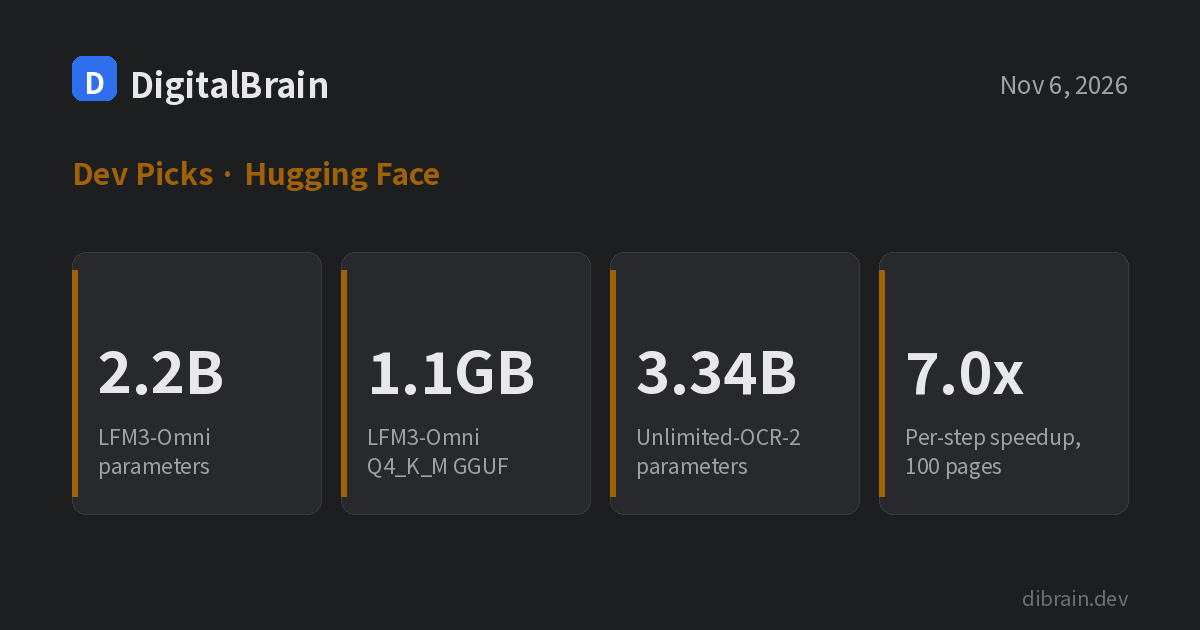
Instead of OCR-ing page by page, it parses a multi-page document in one request so later pages can use earlier context. The usual problem is that attention cost grows with document length; Unlimited-OCR-2 caps the tokens each decoder step attends to with Sparse Reference Sliding Window Attention (SR-SWA). The paper abstract reports 7.0x and 5.6x per-step speedups over full attention and the earlier R-SWA at hundred-page scale, and state-of-the-art results on MPDocBench and Baidu’s new hundred-page benchmark, MarathonDocBench. Those scores are the authors’ own.
Run it with Transformers (model card example, tested on an NVIDIA A800-80GB):
pip install torch==2.13.0 torchvision pillow transformers==4.52.1 huggingface-hub==0.36.0 \
  tokenizers==0.21.4 addict==2.4.0 einops==0.8.2 easydict==1.13
import torch
from transformers import AutoModel, AutoTokenizer

model_name = "baidu/Unlimited-OCR-2"
tokenizer = AutoTokenizer.from_pretrained(model_name, trust_remote_code=True)
model = AutoModel.from_pretrained(model_name, trust_remote_code=True, use_safetensors=True,
                                  torch_dtype=torch.bfloat16).eval().cuda()

# Single page
text = model.infer(tokenizer, image_file="your_doc/page_1.jpg",
                   output_path="output/single", save_results=True)

# Multiple pages in one request, in page order
pages = [f"your_doc/page_{i}.jpg" for i in range(1, 8)]
text, num_tokens = model.infer_multi(tokenizer, image_files=pages,
                                     output_path="output/multi", save_results=True)
The example calls .cuda(), so it expects an NVIDIA GPU as written. For batch work the model card recommends an SGLang server built from a custom wheel.
Where each one actually fits
Liquid AI publishes its own GGUF for LFM3-Omni-2B: 1.1GB for the Q4_K_M model plus 0.29GB for the Q4_K_M vision/audio projector (file list). That is small enough to try on a 4GB board, but nobody has published Raspberry Pi 5 or Jetson numbers yet, so real-time voice chat on that class of hardware is unconfirmed.
Unlimited-OCR-2’s official path is a CUDA GPU with about 6.7GB of BF16 weights. Community GGUF, MLX and LiteRT conversions already exist, but whether SR-SWA and multi-page parsing survive those runtimes is unverified. For now it belongs on a server that turns long PDFs into Markdown.
If you build a robot or kiosk with a microphone and camera and want fewer models in the stack, LFM3-Omni-2B is the one to try first — after checking the revenue cap. If the job is turning hundreds of pages of reports or manuals into structured text, MIT-licensed Unlimited-OCR-2 on a GPU server is the starting point.