Two models on this week’s Hugging Face trending list share a size (9B) and a base (Qwen3.5-9B) but have nothing else in common. One scans long text as compressed images and expands only what it needs. The other is a supervised fine-tune on coding and agent data. Trending ranks come from an aggregator (agents-radar, Sept 28 digest); details were cross-checked against separate write-ups of each model.
LensVLM-9B
- Model card: apple/LensVLM-9B
- Code: apple-aiml-research/ml-lensvlm
- Paper summary: Apple Machine Learning Research
- Publisher: Apple. License: Apple Machine Learning Research Model License (apple-amlr), not Apache-2.0
- Size: 9B, based on Qwen3.5-9B; task: vision-language, long-document QA
- Released: appeared on Apple’s Hugging Face profile Sept 21; code on GitHub Sept 22
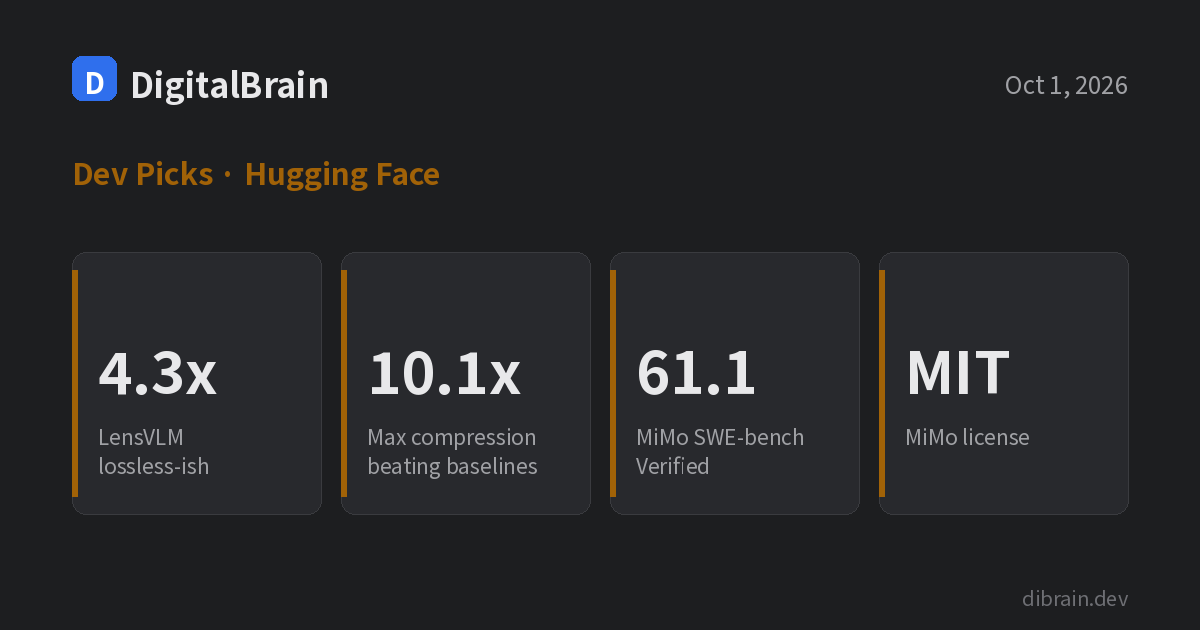
The model reads long text as compressed images and uses learned tools to expand only the pages a question needs. Per Apple’s summary, across seven text QA benchmarks it keeps accuracy comparable to the full-text upper bound at 4.3x effective compression and beats retrieval, text-compression and visual-compression baselines up to 10.1x. The demo script takes 5x, 10x or 15x compression options.
Running it: follow the repository README; the card could not be opened directly here, so no command is printed here. Community GGUF and MLX conversions already exist (bartowski/LensVLM-9B-GGUF, mlx-community/LensVLM-9B-OptiQ-4bit), but whether the compress-and-expand tool loop works in a stock chat runtime is TBC.
MiMo-V2.6-Distill-Qwen-9B
- Model card: XiaomiMiMo/MiMo-V2.6-Distill-Qwen-9B
- Publisher: Xiaomi MiMo. License: MIT
- Size: 9B; Qwen3.5-9B fine-tuned (SFT) on MiMo-generated data
- Released: late September (MiMo V2.6 shipped as Flash-RL, Pro-RL and Distill-Qwen-9B, per a Sept 22 write-up)
Training data spans coding, general agent tasks, visual coding and cybersecurity, and the checkpoint is offered as a starting point for open agentic-RL research. The figures found: SWE-bench Verified 61.1 and SWE-bench Pro 44.6, both avg@3 (summary). The full card table was not checked.
Run it (command confirmed in search results):
vllm serve "XiaomiMiMo/MiMo-V2.6-Distill-Qwen-9B"
That starts an OpenAI-compatible server. For local use there are GGUF builds such as bartowski/MiMo-V2.6-Distill-Qwen-9B-GGUF.
Same size, different job
LensVLM targets cheap reading of long documents; the MiMo distill targets running a coding agent on a small model. Both fit the quantized-9B-on-a-laptop-GPU class, but memory needs and Raspberry Pi 5 feasibility were not confirmed from sources (TBC). Start with LensVLM for document search and summarization pipelines, MiMo for local coding-agent experiments. LensVLM’s Apple-specific license needs reading before commercial use; MIT leaves MiMo nearly unrestricted.